Hard water does not leak or set off an alarm. It works slowly, leaving mineral deposits inside the equipment you use every day. In Riverside that happens faster than in much of California, because the city pumps its water out of the ground.
Here is what the hardness number means, and where it costs you first.
How Hard Is Riverside Tap Water, Exactly?
Riverside’s water averaged 194 mg/L of hardness in 2024, ranging from 180 to 210 mg/L. Those figures come from Riverside Public Utilities’ 2024 Water Quality Report.
Water hardness is the amount of dissolved calcium and magnesium in water, reported as calcium carbonate. The U.S. Geological Survey classifies anything above 180 mg/L as very hard. Riverside clears that line at the bottom of its range, not just on average.
Softener dealers use a different unit. The utility’s report puts one grain per gallon at 17.1 mg/L, so 194 mg/L is 11 grains per gallon.
| Measure | Riverside average | Range | Why your plumber cares |
|---|---|---|---|
| Hardness as calcium carbonate | 194 mg/L (11 grains per gallon) | 180 to 210 mg/L | Forms scale in heaters, fixtures, and appliances |
| Calcium | 63 mg/L | 59 to 67 mg/L | The larger share of the hardness load |
| Total dissolved solids | 350 mg/L | 320 to 380 mg/L | Under the EPA secondary guideline of 500 mg/L |
| pH | 7.8 | 7.5 to 8.2 | Slightly alkaline, which favors scale over corrosion |
Where the Minerals Come From
Riverside’s hardness starts underground. The utility met all of its 2024 supply needs with groundwater from the Bunker Hill and Riverside basins. Water dissolves calcium and magnesium as it moves through rock, so groundwater runs harder than surface supplies.
That is geology, not a treatment failure. The utility reported that its water met or surpassed every state and federal drinking water standard in 2024.
Hardness is not a regulated health risk either. The U.S. Environmental Protection Agency handles it under secondary standards, which cover effects on taste and equipment rather than health.
What Scale Does Inside a Water Heater
Scale is the mineral deposit hard water leaves behind when it is heated. The EPA describes scale as a deposit that builds inside hot water pipes, boilers, and heat exchangers, restricting or even blocking flow.
A tank heater is where most Riverside homeowners meet it. Calcium carbonate settles on the tank floor, between the burner and the water. The burner then pushes heat through a mineral layer instead of into water.
The USGS notes that scale shortens equipment life, raises the cost of heating water, and lowers the efficiency of electric water heaters. A rumble during a heating cycle is often water flashing to steam under that sediment.
Tankless units face the same chemistry in a tighter space. Their heat exchangers move burner heat into water through narrow passages, so a thin film costs more there than in a tank.
Spot It at the Fixtures First
Fixtures show the problem years before a heater fails. Watch for these:
- White crust on faucet aerators and showerheads. An aerator is the small screened insert at a faucet tip that mixes air into the stream.
- Spots or cloudy film on glassware straight out of the dishwasher.
- Soap that lathers poorly, and a slippery feel that lingers after rinsing.
- Weak flow at one fixture while the rest of the house runs normally.
- A water heater that rumbles, pops, or ticks when it fires.
None of these are emergencies. All of them are the same mineral, doing the same thing in different places.
Softener, Filter, or Both?

A softener and a filter solve different problems, and buying the wrong one is an expensive mistake. A water softener removes calcium and magnesium by exchanging them for sodium or potassium, which stops scale from forming. A whole-home filter cuts chlorine taste and odor, but it leaves hardness minerals in the water.
| What you notice | What causes it | What addresses it |
|---|---|---|
| Scale on fixtures, spotted dishes, short appliance life | Calcium and magnesium | Water softener |
| Chlorine taste or smell at the tap | Disinfectant residual in the mains | Whole-home filtration |
| A noisy or slow-recovering heater | Years of deposit on the tank floor | Water heater service before new equipment |
| Weak flow across the whole house | Scale narrowing older supply lines | Repiping assessment |
Check the Local Softener Rules Before You Buy
California lets local agencies restrict residential water softeners. Under California Health and Safety Code section 116786, a local agency may restrict residential softening appliances by ordinance. The restriction covers units that discharge to the community sewer.
The agency has to make findings first. Those include a finding that the limit is needed to meet waste discharge requirements from a regional water quality control board.
Any such ordinance applies going forward only, and cannot force removal of a softener already installed. We at First Class Plumbing and AC confirm the local requirements before quoting a softener.
A Tankless Swap Where the Old Pipe Went Too
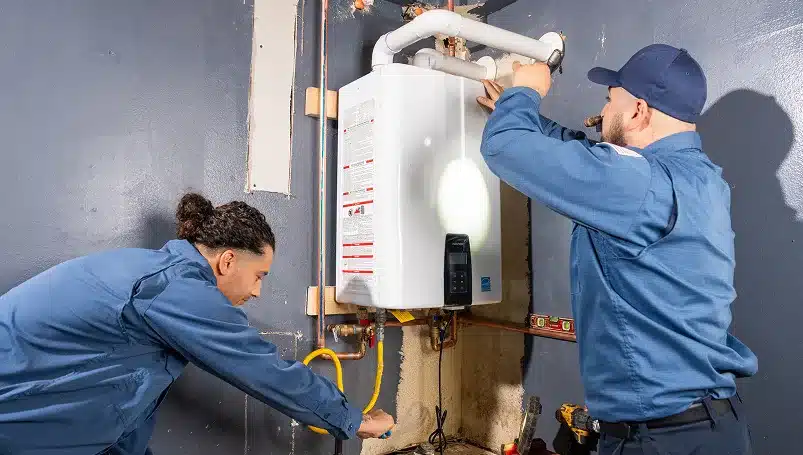
Replacing a water heater exposes the condition of the pipe feeding it. On a recent tankless installation, our crew replaced outdated piping as part of the job rather than tying new equipment to old pipe work.
The customer, Dinesh G, wrote on Google:
“Daniel, Bryan, Matt, and Aron did a great job on installing my tankless water heater. Daniel clearly explained the details and the whole team did an excellent job staying late to complete. They updated outdated piping and installed new pipe work that will last a long time. Thank you”
That sequence is the point. New equipment tied into scaled, aging pipe inherits the old restriction on day one. You can read this review on Google.
Test at Your Own Tap Before You Buy Anything
Here is the step most people skip. The 194 mg/L figure is a system average, and your house sits somewhere in that 180 to 210 mg/L range. A test at your own tap tells you what your equipment is handling.
If your fixtures are crusting or your heater has started making noise, book a visit with our Riverside team. We will test the water, check the heater, and tell you which fix you need. We are a licensed California plumbing contractor, CSLB license 1076022, working across our Riverside County service area.
Frequently Asked Questions
Yes. Hardness is not regulated as a health risk in drinking water. The U.S. Environmental Protection Agency addresses it under secondary standards, which cover taste, appearance, and equipment rather than health. Riverside Public Utilities reported that its water met or surpassed all state and federal drinking water standards in 2024. Hard water is a plumbing problem, not a safety problem.
It depends on what is failing, not on the hardness number alone. Riverside’s supply averaged 194 mg/L, which the U.S. Geological Survey calls very hard, so scale is a realistic concern here. A softener earns its cost when you are replacing crusted fixtures, losing water heaters early, or fighting spotted dishes. It does not fix taste or odor complaints, which come from a different cause.
Softened water prevents the calcium carbonate deposits that form on a heat exchanger when hard water is heated. Tankless heat exchangers use narrow passages, so they are more sensitive to a given thickness of scale than a storage tank is. Every manufacturer sets its own water quality and descaling requirements, and those terms usually appear in the warranty. Check the unit’s documentation rather than assuming a softener ends all maintenance.
No. A standard whole-home filter targets sediment, chlorine taste and odor, and similar contaminants. It does not remove the dissolved calcium and magnesium that make water hard, because those minerals need ion exchange or a comparable process. Homes that want soft water and better taste usually install a softener and a filter together, plumbed in sequence.
Key Takeaways
- Riverside Public Utilities measured average hardness of 194 mg/L, or 11 grains per gallon, in 2024, ranging from 180 to 210 mg/L.
- The U.S. Geological Survey classifies water above 180 mg/L as very hard, so Riverside is very hard across its whole reported range.
- The utility’s report puts one grain per gallon at 17.1 mg/L.
- Riverside met its 2024 supply needs with groundwater from the Bunker Hill and Riverside basins, and groundwater runs harder than surface water.
- The U.S. Environmental Protection Agency defines scale as a deposit that builds inside hot water pipes, boilers, and heat exchangers and restricts flow.
- California Health and Safety Code section 116786 lets a local agency restrict residential softeners that discharge to the community sewer, going forward only.