
When your thermostat is set to 74 degrees, and your AC has been running for four hours straight, but the indoor temperature reads 83 and is still climbing, the system is not broken in the traditional sense. It is running. But it cannot win against the heat load it is facing. This specific situation, where the AC unit is not keeping up even when it appears to be working, comes up constantly across the Inland Empire and Southern California during the peak weeks of summer.
Since 2019, First Class Plumbing and AC has diagnosed this exact problem for homeowners throughout Riverside, Rancho Cucamonga, Glendora, and across the broader San Gabriel Valley. In most cases, the root cause is one of the four issues described below, and in many cases, it is more than one of them working together.
Your System May Have Been Sized for a Milder Climate
This is the most uncomfortable explanation, and it is also one of the most common. A meaningful share of homes in the Inland Empire were built with AC systems sized for design temperatures that no longer reflect what these communities actually experience during the hottest weeks of summer.
HVAC contractors use a load calculation standard called ACCA Manual J to determine the right system size for a given home. That calculation depends heavily on the outdoor design temperature, which represents the peak outdoor temperature the system is engineered to maintain comfort against. In many tracts built across Riverside County and the San Gabriel Valley in the 1980s and 1990s, design temperatures used at the time of construction fell in the low to mid 90s. Today, multiday heat events regularly push those areas past 108 to 112 degrees Fahrenheit.
A system sized to maintain a 20-degree indoor-to-outdoor differential from 95 degrees is a fundamentally different piece of equipment from one sized to handle a 35-degree differential from 110 degrees. The AC unit in your home may have passed every inspection when it was installed and still be wholly inadequate for the heat your neighborhood faces today. The clearest sign: the system runs all day, holds the house at around 81 to 84 degrees, but cannot reach the thermostat setpoint no matter how long it runs. The fix in this scenario is a proper Manual J load calculation followed by a system replacement with equipment sized for current conditions. Recharging refrigerant or cleaning coils will not add capacity that the equipment never had.
A Slow Refrigerant Leak Is Quietly Reducing Your System’s Cooling Output
Refrigerant does not get consumed the way fuel does. A properly sealed system holds the same refrigerant charge for the lifetime of the equipment. When a system gradually loses its ability to keep up with the heat, especially when it handled summer well a season or two ago, a slow refrigerant leak is one of the first things to investigate.
Even a modest refrigerant loss reduces a system’s rated cooling capacity in direct proportion to the amount lost. A system running at 80 percent of its design refrigerant charge delivers roughly 80 percent of its rated BTU output. Under normal operating conditions, that shortfall may be barely noticeable. During a 107-degree heat wave, when the home’s cooling load is at its annual peak, and the system needs every available BTU, that gap becomes the reason the indoor temperature climbs past the setpoint despite hours of continuous operation. The AC is not keeping up in 100-degree weather because it no longer has the capacity it was designed to provide.
Additional signs of low refrigerant include ice forming on the copper refrigerant lines or on the indoor air handler, warm or barely cool air from supply vents after extended runtime, and a system that runs in longer cycles than it used to. Refrigerant handling requires an EPA Section 608-certified technician. More importantly, adding refrigerant without finding and repairing the underlying leak is a temporary fix that will not hold through another cooling season. The correct sequence is to find the leak, repair it, verify the repair holds, and then recharge the system to the manufacturer’s specified pressure.
Contact First Class for leak detection and refrigerant service.
Dirty Condenser Coils Trap Heat Inside Your System When It Needs to Exhaust It
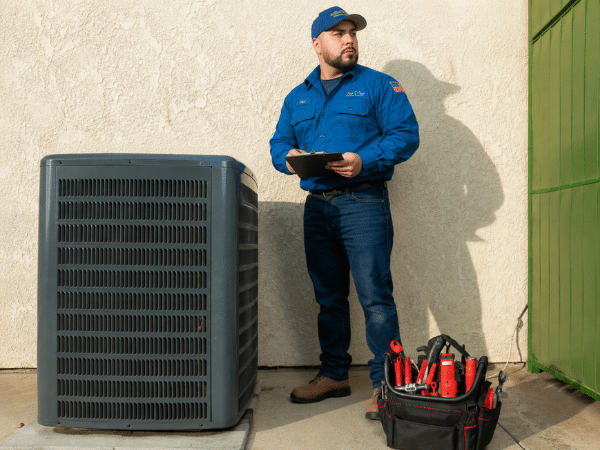
The outdoor condenser unit does one primary job: it exhausts the heat removed from your home into the outside air. To do that effectively, outside air must move freely through the condenser coils. When those coils are caked with dust, cottonwood seeds, dry leaves, or debris from Santa Ana winds, that heat has nowhere to go.
When condenser coils are significantly fouled, the condensing temperature inside the system rises. The compressor works harder, draws more electrical current, and delivers less effective cooling output. Field data and studies referenced by ASHRAE consistently show that heavily fouled condenser coils can reduce system efficiency by 20 to 30 percent or more, depending on severity. On a day when the outdoor temperature is already 106 degrees, adding a 25-percent efficiency penalty on top of that ambient heat load is often exactly what tips the central AC into not keeping up with the weather.
Condenser coil cleaning is a standard part of a professional AC tune-up. It is one of the highest-return maintenance tasks for SoCal homeowners because the region produces so much airborne debris year-round. If your system has not had the condenser coils professionally cleaned in the last 12 months and it is struggling during heat events, this is a logical first step.
Duct Leakage Is Sending Your Cooled Air Into the Attic Instead of Your Home
According to ENERGY STAR, the typical American home loses 20 to 30 percent of its conditioned air through leaks, holes, and poorly connected ducts before that air reaches a vent. In a mild climate, that kind of loss is an efficiency problem. In Southern California during a heat wave, it is a comfort problem that makes the AC unit appear unable to keep up even when the equipment itself is in good condition.
Most residential duct systems in the Inland Empire run through unconditioned attic spaces. In summer, those attic spaces reach 140 to 160 degrees Fahrenheit. When supply ducts leak, you are dumping 70-degree conditioned air directly into that heat. When return ducts leak, you are drawing some of that 150-degree attic air directly into the air handler, which then has to work against it on every cycle. Both problems reduce the cooling your living spaces actually receive and both compound the performance gap on the hottest days of the year.
The signs of significant duct leakage are rooms that stay consistently warmer than others, particularly those farthest from the air handler, higher-than-expected utility bills relative to usage, and a house that takes dramatically longer to recover from a brief period with doors or windows open. Duct sealing is a one-time fix with a lasting impact on comfort and energy costs. If your home qualifies for financing, the cost can be spread over time while the energy and comfort improvements start immediately.
AC Symptom Diagnostic Guide: Cause and Recommended Action
| Symptom | Most Likely Cause | Recommended Action |
|---|---|---|
| System runs all day, never reaches set temperature | Undersized system or extreme heat load beyond design capacity | Professional load calculation, evaluate system replacement |
| AC struggles only on days above 100 degrees | Dirty condenser coils or peak ambient heat stress | Condenser coil cleaning, professional tune-up |
| Some rooms stay hot while others cool normally | Duct leakage or poor air distribution in the system | Duct inspection and sealing |
| AC was fine last summer, but now falls short | A gradual refrigerant leak reduces total capacity | Leak detection, repair, and refrigerant recharge |
| Ice on refrigerant lines or on the indoor unit | Low refrigerant or airflow restriction | Shut the system off, call for a diagnostic immediately |
Why Your AC Often Struggles with More Than One Problem at Once
Real-world heat wave failures rarely trace back to a single isolated cause. The central AC units that cannot keep up during a 110-degree week in Riverside or Rancho Cucamonga are almost always dealing with compounding issues: equipment that was slightly undersized to begin with, minor refrigerant loss that went undetected for two seasons, condenser coils that have not been cleaned since installation, and ductwork that has been quietly bleeding conditioned air since the home was built.
Any one of those problems might not push the system over the edge on a typical summer day. The combination pushes it over the edge on the hardest day of the year, which is also the worst time to deal with a breakdown. That is the case for scheduling a proper diagnostic inspection before summer peaks rather than waiting until something fully stops working. A complete assessment during a professional tune-up visit identifies which of these issues are present and gives a realistic picture of what it will take to get the system performing reliably through peak season.
A Same-Day Diagnostic Call in Riverside That Resolved the Problem
One of our Riverside customers, Eva, noticed her system was not cooling properly and reached out to First Class Plumbing and AC before the summer heat fully set in. Our technician Luke was dispatched the same day. He ran a thorough diagnostic, identified the specific issue causing the underperformance, walked Eva through exactly what he found, and had the system running correctly before the end of the visit.
In Eva’s words: “Luke was professional, knowledgeable, and very efficient. He quickly identified the issue with my AC, explained everything clearly, and had it running perfectly in no time.”
That kind of diagnostic precision matters for the problem described in this article. Knowing whether a struggling AC unit needs a refrigerant recharge, a coil cleaning, a duct inspection, or a replacement conversation requires a technician who measures and tests rather than guesses. If your system is not keeping up with the heat, the right move is a diagnostic visit before a 108-degree day turns the situation into an emergency. First Class also offers emergency AC repair for situations that cannot wait.
Schedule a Diagnostic Before the Next Heat Advisory
If your central AC is not keeping up with the heat this summer, the cause is diagnosable and, in most cases, fixable. First Class Plumbing and AC serves homeowners throughout Riverside, Rancho Cucamonga, Glendora, and the broader Inland Empire and San Gabriel Valley.
We offer same-day scheduling for AC repair and diagnostic visits, and 24/7 emergency AC service for active breakdowns. Book your appointment today.
Frequently Asked Questions
Why does my AC struggle when it is over 100 degrees but work fine on normal days?
This is a capacity problem that only becomes visible when the heat load exceeds what your system can handle. Every air conditioner is rated to maintain a specific indoor-to-outdoor temperature differential. If your system was sized or is currently operating at a level that works adequately at 88 degrees but cannot keep up in 100-degree weather, the remaining margin has been consumed by the added load. The most common causes are a system sized below what current peak temperatures demand, reduced capacity from a gradual refrigerant leak, and dirty condenser coils that reduce heat rejection efficiency under peak outdoor conditions. A licensed technician can measure your system’s actual output and compare it to the calculated load your home places on the equipment at peak temperatures. First Class Plumbing and AC serves Riverside County and surrounding communities with same-day diagnostic appointments.
How do I know if my AC unit is undersized for my home?
The clearest indicator is a system that runs continuously on hot days without ever reaching the thermostat setpoint. A correctly sized system should maintain a roughly 20 to 25 degree differential between indoor and outdoor temperatures under design conditions. If it is 108 degrees outside and your home is 90 degrees inside after hours of continuous operation, the system cannot handle the load it is being asked to carry.
Proper sizing requires an ACCA Manual J load calculation that accounts for your home’s square footage, insulation levels, window area and orientation, ceiling height, and local design temperatures. If your home is more than 15 years old and has never had this verified, it is worth doing before committing to a system replacement to ensure the new equipment is actually sized for current conditions.
Can I recharge my own AC refrigerant if it is running low?
No. Under federal law, refrigerant handling requires EPA Section 608 certification. This applies to purchasing refrigerants in quantities sufficient for charging residential HVAC systems and to the service work itself. Beyond the legal issue, attempting a refrigerant top-off without finding and repairing the underlying leak is an ineffective short-term fix. The refrigerant will continue to leak, the charge will fall again before the end of the season, and the compressor may sustain damage from running in a low-charge condition over time. The correct sequence is finding the leak, repairing it, verifying the repair holds, and then recharging to the manufacturer’s specified pressure. All of that requires licensed equipment and a trained technician. Contact us for AC repair including leak detection and refrigerant recharge.
What does duct sealing cost and is it worth it for a SoCal home?
Duct sealing costs vary depending on the method, the size of the duct system, and the extent of the leakage. Manual mastic sealing of accessible duct connections is the lower-cost option. Aerosol-based systems, which seal leaks from the inside without requiring physical access to every joint, cost more upfront but address leakage in locations that cannot be reached manually. For a home losing 20 to 30 percent of conditioned air through duct leaks, the efficiency improvement after sealing is typically substantial enough to recover the cost within a few cooling seasons. In Southern California, where the AC runs five or more months per year, the payback period is shorter than in milder climates because the savings accumulate faster. Financing options are available to spread the cost of duct sealing over time.
At what point should I replace my AC instead of repairing it again?
Two widely used decision frameworks apply here. The first: multiply the system’s age in years by the proposed repair cost. If the result exceeds 5,000, replacement typically delivers better long-term value than the repair. The second is the 50 percent rule: if a repair costs more than half the price of a new system, replacement is the stronger financial decision. For Inland Empire homeowners specifically, there is a third consideration: if the current system was never properly sized for today’s peak temperatures, repairs will not solve the underlying capacity problem. In that case, replacement with a correctly sized system is the only path to reliable cooling on the hottest days. A technician can walk through both frameworks with you during a diagnostic visit.
Key Takeaways
- A central AC unit that is not keeping up with the heat in Southern California is almost always dealing with one of four problems: undersized equipment, refrigerant loss, dirty condenser coils, or duct leakage. Most serious heat wave failures involve more than one of these at once.
- Many Inland Empire homes were built with systems sized for design temperatures in the low to mid 90s. Heat events that regularly push past 105 to 110 degrees in Riverside and the surrounding region exceed the conditions those systems were engineered to handle.
- Refrigerant loss reduces cooling capacity in direct proportion to the amount lost. A system running at 80 percent of its design refrigerant charge delivers roughly 80 percent of its rated BTU output. In extreme heat, that gap is often why the AC can’t keep up in 100-degree weather.
- According to ENERGY STAR, the typical home loses 20 to 30 percent of conditioned air through duct leaks. In SoCal, where ducts pass through attic spaces reaching 140 to 160 degrees in summer, duct leakage directly undermines cooling performance on the hottest days of the year.
- Fouled condenser coils can reduce system efficiency by 20 to 30 percent or more, compounding the heat stress the system is already under during a heat wave. Professional coil cleaning is part of a standard AC maintenance visit and one of the most effective maintenance steps for SoCal homeowners.
- A diagnostic visit that assesses all four problem areas is more effective than addressing one issue at a time. Compounding factors are the rule, not the exception, for AC units that cannot keep up during heat waves.
- First Class Plumbing and AC (License #1076022) has served the Inland Empire since 2019. Same-day AC repair and 24/7 emergency AC service are available throughout Riverside, Rancho Cucamonga, Glendora, and surrounding areas.
Citations and References
ENERGY STAR, Duct Sealing and Air Distribution Efficiency. https://www.energystar.gov
ASHRAE: Standards and Technical Resources for HVAC Performance and Residential Load Calculations. https://www.ashrae.org
EPA Section 608: Refrigerant Management Program for Stationary Refrigeration and Air Conditioning Equipment. https://www.epa.gov/section608
U.S. Department of Energy, Energy Saver: Home Cooling and Air Conditioning Efficiency. https://www.energy.gov/energysaver/home-heating-systems